New profile posts

I went back on sway while I still have kubuntu. I just keep working same style anyway so why not, and all this clicking feels so slow after I got used to this speed again. hahah :D
Installed Linux Mint on two older Windows systems and my Apple iMac and I'm very pleased with the result. My older iMac 16.3 however doesn't wake-up when it is switched to sleep mode, my solution is that I've disabled this mode. Has anybody experience with a solution to solve this?
Alexzee
Alexzee
No, I just keep sleep mode and hibernate turned off.
I've been banging my head against the wall with those RAM settings. Turns out the presets are just wrong. No chance in hell does it boot on those default EXPO settings.

Regardless, two of the four RAM sticks are shot, probably out of the factory. Gonna send them back for replacements, then see what I can do with manually tuning in the RAM settings. Right now I've got 5600MHz memory running in single channel 3600. (Facepalm)
While installing Rstudio it shows me this error while installing through terminal how to solve this problem??

~$ rstudio
[20867:0228/124746.323204:FATAL:setuid_sandbox_host.cc(158)] The SUID sandbox helper binary was found, but is not configured correctly. Rather than run without sandboxing I'm aborting now. You need to make sure that /usr/lib/rstudio/chrome-sandbox is owned by root and has mode 4755.
Trace/breakpoint trap (core dumped)
Stupid day today, got to sit in the car with the engine running for about 2 hrs whilst the satnav updates. [Approx 14gb of updates via USB] the car is on a public highway so to be legal in the UK i have to be in the driver's seat if the engine is running and wearing a seat belt, although I am not going anywhere. Still its only once a year
Rocketing-warp9
Rocketing-warp9
Reminds me of a old computer that would never stop updating... It became A running Joke in school when it would update for hours.. then fail to update and rollback... Aren't updates fun? :) Anyway, glad to hear it's over with.
PhantomShadow
PhantomShadow
Is it just me or do many of the so-called "safety laws" almost seem to be written out of malicious intent?

many of them cause frustration and delays for people and cause confusion and sometimes even cause danger in other ways.
Brickwizard
Brickwizard
its the way the world has had to go, countries where litigation is the norm [us for example] lawmakers need to screw down every nut and bolt to remove loopholes, but laws still have to be simple enough for what we call the lowest common denominator [those that lack any sense] one of my favourite would be the health and safety sign above an industrial gas range that states, Warning this appliance may get hot during use.
I should probably not have started making AI album art for my audiobook series cards… because now it turned out so good that I feel like I have to do it for all of them

But honestly, the default “series cover” for audiobooks is usually just Book 1 reused, and it doesn’t always look that great when you’re trying to build a clean overview.

So this is probably what I’ll do:
slowly, series by series, I’ll make custom album art for them over time.

The nice part is that my homemade BookLibConnect setup now gives me a much better overview anyway:
  • Read
  • Own/in Album
  • Goodreads Review
So even before everything gets custom art, it already works way better for tracking progress.

It’s one of those “I made the system better… and now I accidentally created more work for myself” moments
But honestly, I like how it looks now.

Also, I own almost all of Daniel Schinhofen’s books. I thought I was only missing 2 series, but I didn’t notice he had started a new one, so I’m actually missing 3 series now.

I’m also missing the last book in Aether’s Revival, because it came out shortly after I finished the series, so I never got around to it. I still need to buy it and listen to it.

But yeah I’m really close to having finished almost all of his books by now.


990d171b-654a-43a0-9bf1-580e843e8880.png
Been up since 4 AM and still going.

Worked more on BookLibConnect today, and it’s starting to come together in a way I can actually use.

A few things I’m really happy with now:
  • R = Read (so R3/14 means I’ve read/listened to 3 out of 14)
  • 14/14 = how many tracks/files are there out of how many I own/expect for that album
  • The metadata box is more or less done now
  • The artist view shows progress too:
    • one number = how many completed
    • the other number = how many I have total
That kind of visual overview is exactly what I wanted. I don’t want to dig through menus every time just to see what’s finished and what’s missing.

It’s still a lot of testing, rescanning, checking metadata, fixing UI stuff, and doing small adjustments over and over, but that’s the part that makes it usable instead of just “it runs.”

Been a long day already, but this is the kind of progress that feels worth it.
2026-02-24-12-06-1.png
2026-02-24-12-06.png

2026-02-24-12-06-2.png
BookLibConnect – Development Progress (PySide6 / Wayland / Metadata Handling)

Quick dev update on BookLibConnect.

Stack:
  • Python 3
  • PySide6 (Qt 6)
  • mutagen for audio metadata
  • Native Linux target (Wayland-first, X11 fallback)
  • Flatpak packaging in progress
What’s currently stable:

• Album view with cover detection (folder + per-track sidecar fallback)
• Embedded cover writing
• Metadata editing (title, artist, album, album artist, year, genre, track #)
• Track progress tracking (14/14 indicator)
• Auto-rename on save (optional)
• Selection model behavior mostly normalized

Recent fixes:
  • QTableWidget selection signal loop causing metadata pane desync
  • First-item selection not loading metadata unless re-selected
  • Signal blocking cleanup with QSignalBlocker
  • Wayland rendering alignment inconsistencies
  • Horizontal scroll + dynamic column width behavior
Still refining:
  • Edge-case selection state after rescan
  • Metadata reload consistency vs. in-memory state
  • Model/view refactor consideration (may migrate away from QTableWidget)
  • Performance under large libraries
  • Better separation between UI state and file state
The goal isn’t to build “another media player.”
It’s a Linux-native metadata control tool for audiobook libraries that doesn’t fight the filesystem.

No Electron. No cloud dependency. No subscription model. Just files, metadata, and control.

Closer than it was last month. Not done yet.

2026-02-22-20-03.png
2026-02-22-20-02.png
I’m getting there… slowly.

I’ve been rebuilding my old audiobook tool into a proper Flatpak desktop app (BookLibConnect), and honestly: so far it’s been easier to work on than my old “Flask + Python web app” setup. No weird web UI juggling, no constant “why did this break now” feeling. There haven’t been any real problems yet it’s just slow progress, one piece at a time.

Right now the app is still early, but the basics are starting to come together. Set library root, rescan, and it pulls in my library structure and shows the author view (see screenshot). It’s not feature-complete, not polished, and definitely not ready for anyone to depend on… but it’s moving in the right direction.

If this works out the way I want, I might actually share it later. I like the idea of having a clean, installable Linux app instead of a pile of scripts and a browser page.

So far it’s only tested and built on KDE Wayland (Qt: wayland). I know that doesn’t mean much until it’s tested on other desktops/distros, but one thing at a time.

2026-02-21-21-06.png
Title: From my old Flask/Python web app to a real Flatpak desktop app (BookLibConnect) PT1

I’ve been running an audiobook manager/tracker as a Python + Flask web app for a while, and honestly… I’m tired of it being “a pile of scripts + a web UI” that I constantly have to babysit.

The old project was very “me” in style. I built a full theme system with CSS variables, instant theme switching (no reload), and I went a bit crazy with it:

  • Dark Mode for night listening (my default)
  • Winter Mode with a colder look, frosted-glass UI, and a subtle snow overlay/particles
  • Cover-focused browsing, track lists, metadata workflow ideas, the whole “this is my personal library hub” vibe
It looked great, and the theme engine was fun to build… but maintaining it as a Flask web tool is just annoying long-term. Dependencies, browser weirdness, “is this running on the server / is it local / what broke this time”, and it always ends up feeling like a project held together with duct tape.

So I’m rebuilding it as an actual desktop app, packaged as a Flatpak.

New app name: BookLibConnect.
Goal: a clean local library manager that doesn’t need a browser, doesn’t need random setup steps, and can be installed like a normal app.

Current status (PT1):

  • Set Library Root
  • Rescan library
  • Shows author/book + cover art
  • Track list with file name, size, and modified date
So far I’ve only tested this on KDE Wayland (Qt: wayland). It’s early, it’s rough, and it’s nowhere near what my Flask app grew into, but it’s finally going in a direction that feels sustainable.

PT1 screenshot is attached.

If anyone here has practical Flatpak advice (Qt + Python, file access/portals, “don’t do it like this” warnings), I’m all ears.

1210f9cd-3fdb-4fca-9592-07de3f7ab736.png
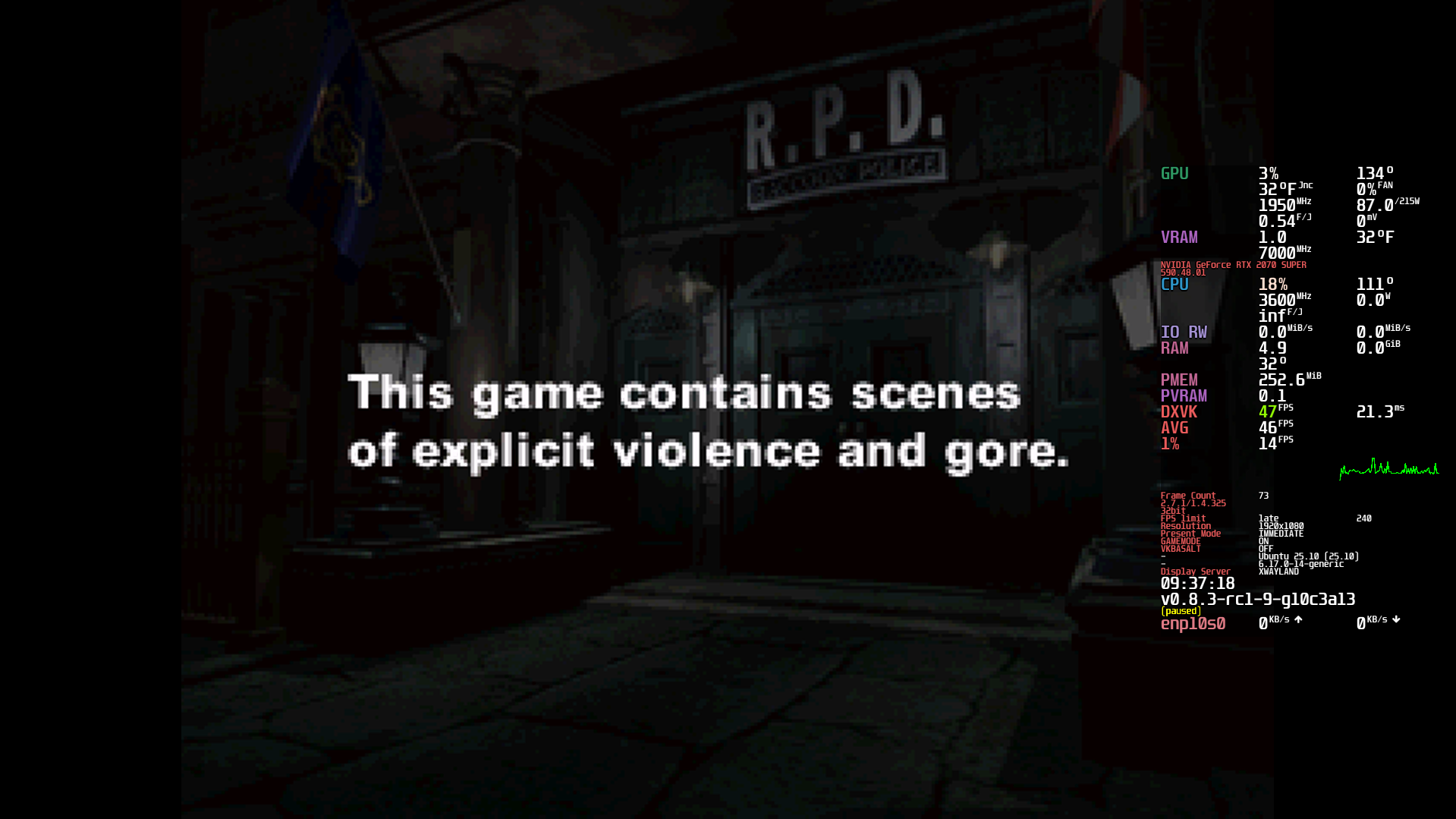
How I Got Resident Evil 2 (Classic GOG) Working on Linux + MangoHud
After fighting with this way longer than I expected, I finally got Resident Evil 2 (original, not the remake) working properly on Linux with:
  • Wine (not Proton)
  • DXVK
  • MangoHud
  • NVIDIA GPU
  • Proper 32-bit support
Posting this in case it saves someone else the headache.


The Game​

This is the original 1998 Resident Evil 2 (GOG version) — not RE2 Remake.

The GOG version uses old DirectDraw / Direct3D 7/9, which can be tricky on Linux.


The Problems I Had​

  1. ❌ “Failed to initialize DIRECTX(R)” error
  2. ❌ MangoHud not showing at all
  3. ❌ Weird libMangoHud_shim.so preload errors
  4. ❌ Lutris runtime complaining
  5. ❌ DXVK not always hooking correctly

✅ What Actually Fixed It​

1️⃣ I Had To Enable DXVK​

The game will not behave correctly on plain Wine’s DirectDraw.

In Lutris:
  • Enable DXVK
  • Use Vulkan
  • Make sure NVIDIA Vulkan drivers are installed
After that, the DXVK overlay appeared, confirming D3D9 → Vulkan translation was working.


2️⃣ I Had To Activate Voodoo (Important)​

Without Voodoo / proper DDraw handling, the game threw:

Failed to initialize DIRECTX(R)
After enabling Voodoo (or proper DDraw override), the DirectX error disappeared.


3️⃣ The BIG One: MangoHud Was Missing 32-Bit Support​

This was the real problem.

Classic RE2 is a 32-bit game.

My MangoHud installation only had 64-bit libraries, so Wine couldn’t hook into it.

That’s why I kept getting:
Code:
ERROR: ld.so: object 'libMangoHud_shim.so' from LD_PRELOAD cannot be preloaded
It wasn’t a Lutris issue.
It wasn’t a game issue.
It was missing 32-bit MangoHud.


The Fix: Recompile MangoHud With 32-bit Support​

I cloned MangoHud and rebuilt it properly:

Code:
git clone --recurse-submodules https://github.com/flightlessmango/MangoHud.git
cd MangoHud
./build.sh clean
sudo ./build.sh install
After installing, I verified:
Code:
/usr/lib/mangohud/lib64<br>/usr/lib/mangohud/lib32
Both must exist.

Especially:
Code:
lib32/libMangoHud.so
lib32/libMangoHud_shim.so
Once both were present, MangoHud finally worked in RE2.


Final Working Setup​

  • Wine (not Proton)
  • DXVK enabled
  • Voodoo enabled
  • MangoHud compiled with 32-bit support
  • NVIDIA Vulkan driver active
  • Waylands
Now it runs:
D3D9 → DXVK → Vulkan → MangoHud overlay
And everything works perfectly.


Important Lessons​

  • Old Windows games = almost always 32-bit
  • MangoHud MUST have lib32 installed
  • If you see preload shim errors, check 32-bit libs
  • DXVK works even for classic RE games
  • DirectDraw errors are usually DDraw/Voodoo related

Result​

Resident Evil 1-3 classic GOG now run on Linux with:
  • FPS overlay
  • GPU monitoring
  • Vulkan backend
  • No DirectX errors
Honestly feels amazing getting a 1998 game running cleanly on modern Linux + Vulkan.

2026-02-15-09-37.png
I almost own all of his audiobooks, and I’m getting close to finishing only 19 audiobooks left. DD makes up 10 of those 19. My next series is AO, since book 5 of RD hasn’t been released as an audiobook yet, so I need to wait for that one.
2026-02-10-15-36.png
image.png

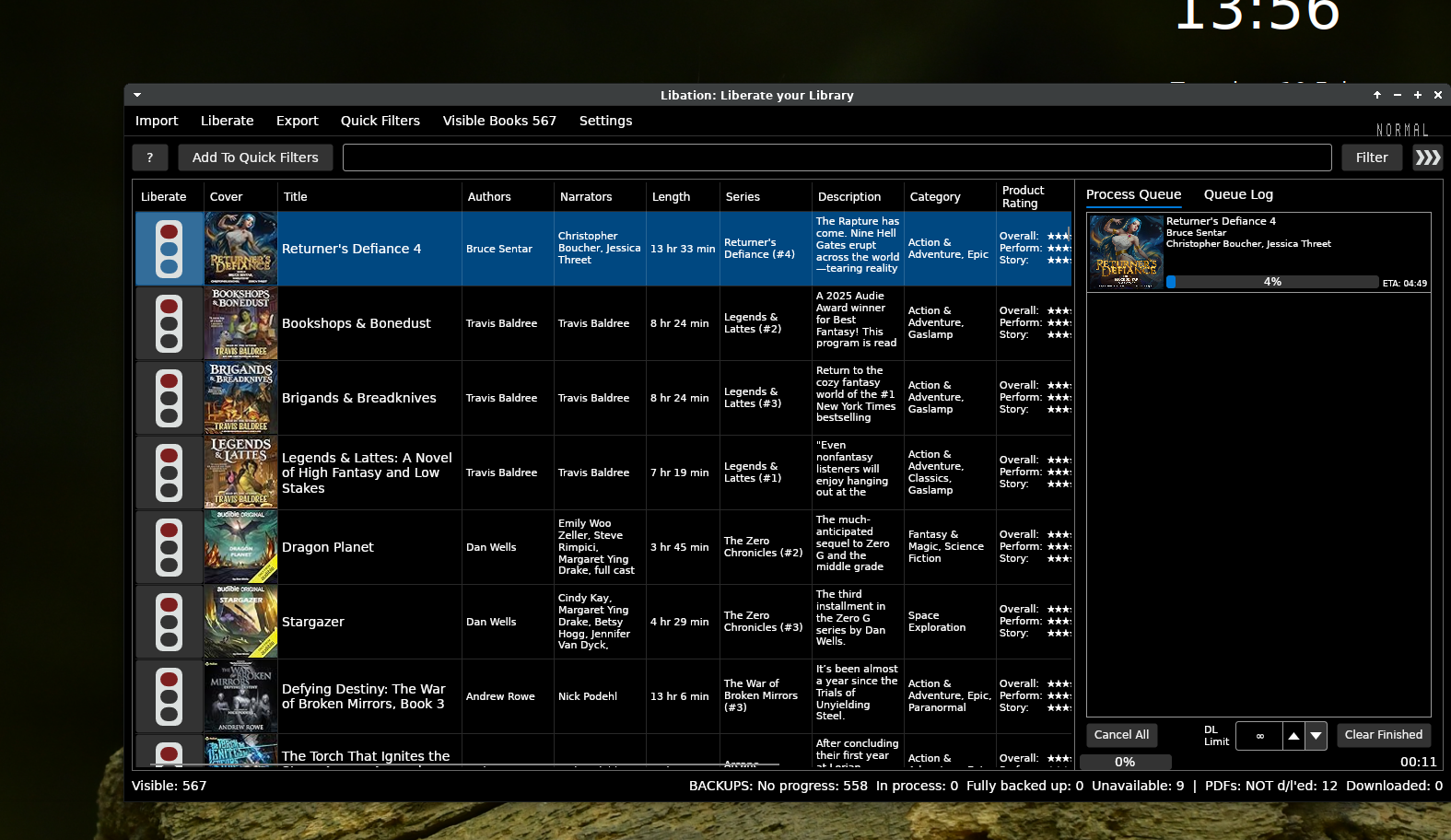
Small realization moment for me recently: I honestly forgot (or never realized) that Libation has a native Linux version. I’d been mentally grouping it with tools I assumed were Windows-only.

Turns out… yeah, it works great on Linux.

So at this point, I feel like I’ve got everything I need on Linux for Audible, backups, MP3 conversion, and general library management. Between the native app and the CLI tools, there’s really no gap anymore.

The only thing I still keep Windows around for is video editing.

I’ve tried a lot of editors over the years, on multiple platforms, and for my use case nothing touches PowerDirector. I can render a 4K, 1-hour video in ~10–12 minutes, which is something no other editor I’ve personally used can match. That’s why I’ve supported it for over 12 years, buying every major version as it comes out. If you just want to get videos done efficiently, it’s unbeatable.

That said, everything else I care about now lives comfortably on Linux. Between native tools like Libation and solid open-source/CLI options, I’m finally at the point where Linux isn’t “almost enough” it’s just enough.
2026-02-10-12-46.png


I wanted to share a small win I had recently, in case it helps someone else.

I managed to get Book Lib Connect (Audible downloader) running successfully under Wine on Linux. It launches cleanly, connects to Audible, downloads audiobooks, and exports them correctly. So from a functional point of view, it does work in Wine.

That said, this isn’t my ideal solution.

The tool only outputs M4B, and my end goal is MP3, so this setup is more of a fallback option for me in case I can’t get my preferred tool working later. Still, having a reliable backup that runs on Linux is a big plus.

I’m still experimenting with other options that better fit my workflow, but I figured this was worth sharing since Audible + Linux can be a pain point.
If anyone has recommendations for Audible → MP3 workflows on Linux (native or Wine), I’m definitely open to suggestions.
Thanks, and happy to answer questions if it helps someone else
Getting back to Linux after several years hiatus. Currently running Ubuntu 24.04 LTS on a HP Laptop, and also running Linux Mint 22.3 on an Acer Spin Laptop. Plan to load latest release of Fedora on Virtualbox, on my Ubuntu laptop to a 256GB portable flash disk.
Linux Mint XFCE every time i boot my PC it takes me to emergency mode does anyone know why that happens and maybe how i can fix it?
Brickwizard
Brickwizard
Post your question on the mint forum, include your machine details, and information on how long you had the problem and if you have changed any setting or instated any updates
Top