Browsers launch faster on Windows.

Debian_SuperUser

Active Member
Joined
Mar 18, 2024
Messages
161
Reaction score
41
Credits
1,949
I have tested on multiple computers. All browsers, Firefox, Chromium and their derivatives launch faster on Windows. Now yes, they still do launch acceptably fast on Linux, but the delay is noticeable.

I think this is about the rendering only. First of all, no I am not talking about the first launch where the memory isn't cached. The subsequent runs where they are cached in memory, and the launch time is indeed very stable on every run at least. Firefox launches slightly faster than Chromium. Same on Windows (man Firefox really does load fast on Windows, didn't know my computer isn't that trash after all). And also programs in X11 also launch very slightly faster than on Wayland (native that is) under my observation.

No matter how much preloading or loading into headless mode or whatever I try, they launch slightly slower on Linux. I think the only minimal difference I see is when they are already open and I open a new window or something. So I think this is all about the rendering which is slower on Linux.

Also I am not entirely sure about this, but with an interesting observation, my other machine with a faster CPU does launch Chromium faster than on this one. But on Windows, surprisingly, I tried under clocking my CPU by a lot (1.69 from 4.2 GHz), and yet If I do remember correctly, the launch time of Thorium (okay it wasn't Chromium, but similar) was still probably faster than on Linux, and it only got slightly faster on normal clock speed. Is this an optimization thing that Linux completely lacks from the programs?

I tested native programs, not containerized ones. Has anybody also experienced this?


I'd be interested in seeing real-world data. It's not that I think you're incorrect. It's just that I like data.

If I had to guess, my first guess is that the browsers concentrate their efforts on Windows. They'll optimize for Windows and Linux is a supported, but second-class, citizen. To be fair, the majority of their users will be using Windows.

If I had to have a second guess, perhaps tied into the first guess, I'd guess that Windows knows which applications you're using and will load those applications into cache to make them open faster.

Linux will leave some stuff in the cache when you close an application. They do that so that the application loads faster when you restart it. I'm sure Windows also does that -- but I wouldn't be surprised if they just kept a list of regularly opened applications and cached parts of them ahead of time.
 
striker-fired
less moving parts... no going back. Once you have pulled the (smoother) trigger....that's it !

eg, a glock 19

I am not so sure the the inbuilt security features on windows are as strictly enforced as they are on the glock and similar firearms
 
Last edited:
If I had to guess, my first guess is that the browsers concentrate their efforts on Windows. They'll optimize for Windows and Linux is a supported, but second-class, citizen. To be fair, the majority of their users will be using Windows.

If I had to have a second guess, perhaps tied into the first guess, I'd guess that Windows knows which applications you're using and will load those applications into cache to make them open faster.
It's true for windows store 'apps' but not true for native programs.
Windows will launch them during login so they run in background, and you end up opening already started programs.

To my knowledge native programs have no means of preloading, witch exception to services or daemons.
 
Much to about nothing.

Unwatching this thread
 
I have tested on multiple computers. All browsers, Firefox, Chromium and their derivatives launch faster on Windows. Now yes, they still do launch acceptably fast on Linux, but the delay is noticeable.

I think this is about the rendering only. First of all, no I am not talking about the first launch where the memory isn't cached. The subsequent runs where they are cached in memory, and the launch time is indeed very stable on every run at least. Firefox launches slightly faster than Chromium. Same on Windows (man Firefox really does load fast on Windows, didn't know my computer isn't that trash after all). And also programs in X11 also launch very slightly faster than on Wayland (native that is) under my observation.

No matter how much preloading or loading into headless mode or whatever I try, they launch slightly slower on Linux. I think the only minimal difference I see is when they are already open and I open a new window or something. So I think this is all about the rendering which is slower on Linux.

Also I am not entirely sure about this, but with an interesting observation, my other machine with a faster CPU does launch Chromium faster than on this one. But on Windows, surprisingly, I tried under clocking my CPU by a lot (1.69 from 4.2 GHz), and yet If I do remember correctly, the launch time of Thorium (okay it wasn't Chromium, but similar) was still probably faster than on Linux, and it only got slightly faster on normal clock speed. Is this an optimization thing that Linux completely lacks from the programs?

I tested native programs, not containerized ones. Has anybody also experienced this?
Whilst there's not much interest here in MS speediness, there was interest in the speediness of browsers in linux opening on screen. The following are some findings for two browsers, midori and mullvad.

The script, rather hastily composed, was the following. It calls a browser and tries to output the time it takes for the window to appear from the time of commanding it:
Code:
#!/bin/bash

BROWSER=$1
WINDOW_NAME=$1
START_TIME=$(date +%s.%N)

$1
echo "start time: $START_TIME" > /tmp/timesfile
echo "window name: $WINDOW_NAME" >> /tmp/timesfile


# wait until the window appears
while ! wmctrl -l | grep -i -q "$WINDOW_NAME"; do
  sleep 0.1
done
#
END_TIME=$(date +%s.%N)
#
echo "end time: $END_TIME" >> /tmp/timesfile

ELAPSED_TIME=$(echo "$END_TIME - $START_TIME" | bc)

echo "elapsed time: $ELAPSED_TIME" >> /tmp/timesfile
#

It was named: browser-time, and it ran thus from a terminal:
Code:
$ browser-time midori
$ browser-time mullvad
One needs to have the respective names actually call the browsers they are referring to which is how it works on this particular machine.

It may actually not be measuring what the OP is interested in, but it is what it is notwithstanding.

The results are sent to a file in /tmp for convenience.

The result for midori show it took 685636376 nanoseconds
Code:
[~]$ cat /tmp/timesfile
start time: 1760773315.754775281
window name: midori
end time: 1760773316.440411657
elapsed time: .685636376

For mullvad, it was 932368110 nanoseconds.
Code:
[~]$ cat /tmp/timesfile
start time: 1760773479.191143693
window name: mullvad
end time: 1760773480.123511803
elapsed time: .932368110

Bearing in mind that a nanosecond is a billionth of a second, there doesn't appear to be any concern here with browser start up times, but for MS I can't say :-) .
 
Last edited:
less moving parts... no going back. Once you have pulled the (smoother) trigger....that's it !

eg, a glock 19

I am not so sure the the inbuilt security features on windows are as strictly enforced as they are on the glock and similar firearms
I was thinking along the lines of the always half-cocked design.
 
Stupid question here:

The op wrote. "...am not talking about the first launch where the memory isn't cached...".

I usually have my browsers set to delete just about everything upon closing. Cache, cookies, history, whatever. No matter if it was Win7 or now Linux. So, of course they load a lot slower than they would if they'd had all the stuff ready to grab in their cache.

Is it even feasible to compare?

I mean, I'm fairly sure my Firefox would load like a rocket without any extensions and all possible 'remember-every-little-crap' options enabled, but that surely wouldn't be desirable?

As far as I know, Linux goes a different route than Windows, maybe putting more attention on security given that it is all open source. So what sense does it make to compare if program x goes faster here than there?

Feels like the guy bragging, "My race horse runs much faster than your draft horse!" "Oh yeah? Let me see him pull a ton of bricks." Not saying that one os is a draft horse here, just pointing out that you cannot compare apples to oranges.

Sorry for butting in like that, just trying to understand.
 
Whilst there's not much interest here in MS speediness, there was interest in the speediness of browsers in linux opening on screen.
@osprey :-

Not too sure how relevant this is nowadays, especially since many of us now use the 'portable' browser variants in Puppyland, and start them differently. However:-

I can't speak for any of the other Chromium-based 'clones', but for Chrome, certainly, there used to be a specific "--switch" for the exec line of the launch 'wrapper':-

Code:
--silent-launch

....whose purpose was exactly this; to launch the browser in the background - whenever you wanted, often of course at boot (or login) - so that when you went to 'open' the browser, it appeared instantaneous.....because it WAS already 'running'.

Around 12 years ago, one of our members built a Puppy called ChromebookPup, intended to emulate the browser-centric nature of a Chromebook, based around the then-current 'Precise' Puppy, in its final guise of v5.7.1, and using Openbox & Tint2 for its WM and launch panel. He used the above '--switch' in a startup script in /etc/init.d.....and, just like a Chromebook, the browser launched instantly, with NO delay.

Which was the intention.

I believe that particular '--switch' has long since been deprecated. Myself, I can't find it any longer.....not for want of looking!


Mike. ;)
 
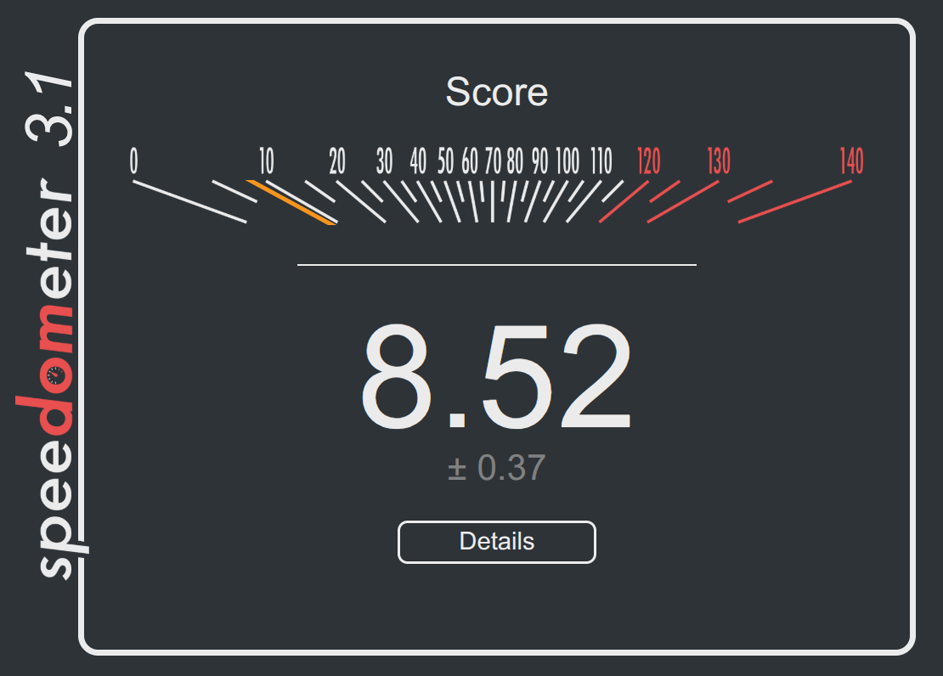
Is mine better or worse than yours?

browsertest firefox.jpg
 
Open details and that will display results.

Screenshot.png
 
I'm still not sure... but according to the line on top, mine is 2.something ms slower than yours.

Well, doesn't matter. I'm not the fastest on my feet anymore, either... ;)

browsertest firefox2.jpg
 
Whatever it is it's not noticeable to the human eye and I don't hold much faith in benchmarks.

As long as my browser opens and goes where I request I'm happy.
 
Browsers launch faster in windoze...do they and so does the sypware and viruses.
1760828157994.gif
 
It's probably for the initiated only...

... but I'm sure glad I'm not the only one who cannot make head or tails of it.
 
Bottom line open the details and look for the time.

Mine is 4.65ms.

That's it nothing earth shaking. ;)

Screenshot.png
 
Last edited:


Follow Linux.org

Members online


Top