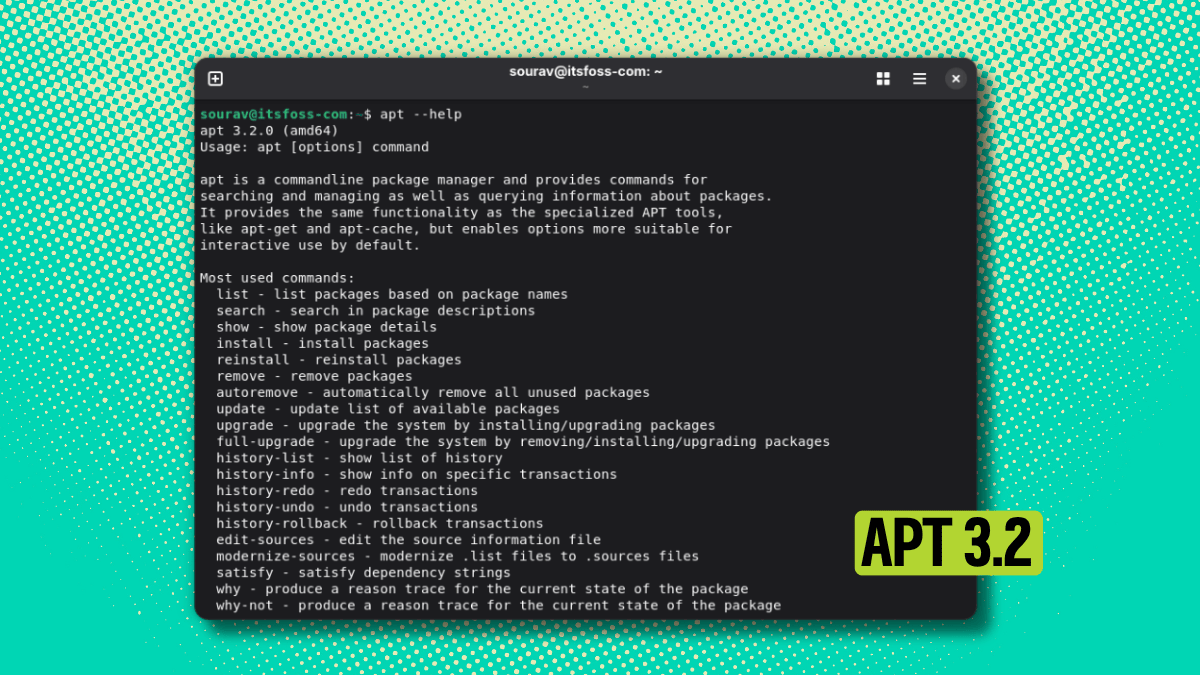
For those who use Apt package management.

It's about darned time.

Well, sort of... I can't think of a time that I've needed to do so in the past decade. However, I see people on here using a backup to get back to where they were before they installed stuff. This should be useful for those people.

As an aside, I'm not sure why my installed OSes don't break. I don't take good care of them. Heck, I install applications just to see if I can spot problems that people are reporting. I have applications that I've used once.

I just keep blindly mashing the update button. When an OS upgrade is available, I jump on that as soon as I can make the time to babysit it. I'm not doing anything special to keep my OS running. They just don't want to break.
And I thought it was just me--thanks!


And I thought it was just me--thanks!

It reminds me of an old Honda. I'm not particularly careful with it, and yet it still keeps running.

It never seems to break beyond what I can (usually trivially) fix. I would only consider it really broken if I couldn't easily fix it.
 
not sure though if yum/dnf looks in the local cache, as the Arch Linux "downgrade" command does.
dnf does not keep package cache on default fedora. If you manually configure it, it will look of course but that's more than one toggle option (keepcache) to set up.
 
On Fedora and RHEL. to @f33dm3bits and @dos2unix - does the feature there store the data for rollback on the subject distro, or can it be directed to an external drive?

It's in the OS. note this is only for OS and applications, not home directory stuff at all.
I can roll back to hernel 6.19.5 (currently on 6.19.11) or from VLC 3.0.24 to 3.0.23, but I can't
roll back my_resume_2026.odt.

But honestly, Ypu ho,me files aren't likely to break anything, usually it's a system file, library or kernel
that's going to break something, having the ability roll back to a previous kernel/glib on the fly is pretty handy.
 
It reminds me of an old Honda. I'm not particularly careful with it, and yet it still keeps running.

It never seems to break beyond what I can (usually trivially) fix. I would only consider it really broken if I couldn't easily fix it.
And I have a (sort of) old Honda, same deal. I do to it what I'm supposed to do when I'm supposed to do it (it pretty much tells me) and we're going on 12 years of motoring bliss. I drive it for the same reasons I run Mint Xfce.
 
And I have a (sort of) old Honda, same deal.

The story is too long, and too off-topic, to share here. Basically, I'd recently retired. I bought an old Honda just to drive it more or less randomly around the country for what turned out to be six months.

There was a lot of mental stuff going on (all good stuff) and it was tons of fun. It turns out that I don't really have any serious regrets. If i could go back to live my life all over again, I'd do mostly the same things.

I realize that such is not true for everyone...

Which made me think...

APT is getting a feature that real humans would love to have -- the ability to rollback to a previous configuration.
 
Sounds like we're traveling the same road, maybe just different lanes. In 2015 I bought a brand new Fit (it's a Jazz everywhere else in the world) because a day laborer ran a stop sign in his Buick and totaled my much beloved 2002 Toyota Tacoma. I still had five years until retirement so I thought a Fit/Jazz would make a great computer equipment hauler, a good gig wagon if I ever found another band, and a cross country road trip car for after retirement.

I don't haul computers anymore, live music is dead where I live, and I haven't gone anywhere yet. Florida is 75 miles away and the only time I go there is to visit Mayo Clinic. I drive right down A-1-A but instead of going to a beach bar, I go to the hospital. I have different responsibilities now, not fewer.

I'm grateful every day for most of my life choices. Deciding IT was the future in 1982 was the best decision I ever took. I don't think I'd start out again by becoming a COBOL programmer, but it introduced me to the hardware and OSes, and I got to see the disc pack dance.

Happy to still be here in 2026.

-g=c800:5

edit: off topic, I did it again, sorry. It gets lonely out here.
 
I don't think I'd start out again by becoming a COBOL programmer, but it introduced me to the hardware and OSes, and I got to see the disc pack dance.

I probably shouldn't tell you this, but I'm gonna...

There's a lot of old COBOL still running on big iron. Many of the people who were good with COBOL aren't available in large numbers.

If you're good with COBOL and you're willing to work as a consultant, you can pretty much name your price. You can easily make well into the six-figure category. With overtime, you're maybe making $200k. If you're willing to work remotely, you might make half of that.

Whenever I think nostalgically about my working days, I just look around me. If it's too nagging, I just look out the window, out across the valley. That cures any thoughts like that. Plus, I figure I've done enough. I've had many experiences, achieved many accomplishments, and the good fortune to be surrounded by good people. So, I don't need to go back to gainful employment.
 
I was good with COBOL but immediately hated the work environment. I (still) loved data centers, but hated being the guy chained to the terminal. I wanted to be the guy the terminal slave called when his login was broken. And off I went to the digital frontier at the time.

I got a few really tempting offers starting around 1998 to write code again, and back then I still remembered enough I might could have pulled it off. But I still didn't want to do that and besides, Novell sales and support were still good and I was busy getting businesses hooked up to the internet. Bonded modems? ISDN? DSL? Cubix, Citrix, Netware Anyware, 66 blocks and missing punch down tools, Cat3 preinstalled for the bonus win.

If there's one thing on this Earth I hate worse than cheap tape drives, it's shared MS Access databases. There, just had to get that off my chest.

I was a Novell dealer learning NT4 on the side because I could hear footsteps. I have Novell to thank for introducing me to Linux with a free copy of SuSE 9.1, then 9.3. I guess they could hear the footsteps too! That was all before 2000, and I spent the next 20 years trying to drink from a firehose. Now it's all virtual, you can't get cut and bleed on the bare metal anymore.

I'm looking at a sailboat on the Intracoastal as I type this. If I get up and walk over to the window, I can look straight out the sound into the Atlantic. I can throw an ammo can of my latest handloads in the car and be at the range in 20 minutes, or I can be at the boat ramp in five. I got rid of my smartphone, don't need it. I work for my family now, but rarely do I ever get to tinker with hardware that isn't mine. But once upon a time I saw and did some cool things.

I'm glad we made it, I hope everyone else does too. ;-/
 
On Fedora and RHEL. to @f33dm3bits and @dos2unix - does the feature there store the data for rollback on the subject distro, or can it be directed to an external drive?

It's nt really a "backuP" per se like timeshift. But rather is OS roll back.
I was running kernelA with glibA and KDEA yestrday. There was an update, not I can run KernelB, glibB, and KDEB., usually that works (99%.9%).. but if it doesnt work I just pick the previous versuibn in the grub menu, and I'm back on version A. It didn't come from an external backup, (no timeshift needed).. both version of everything were on my main OS drive at the same time.
I suspect very very few fedora/rhel users also use timeshift.

Honestly, I never do back-ups at a disk,/OS level, I back up my home dir, and projects like cofing, git, web pages, databases, etc.. and thats it, I use a local kickstart, so worst case. I rebuild my entire OS exactly as it was before in about 4 or 5 mins.
 
dnf does not keep package cache on default fedora. If you manually configure it, it will look of course but that's more than one toggle option (keepcache) to set up

It's not cached (well it can be).. but the files live side by side on the drive and the same time.


Follow Linux.org

Members online


Top